
Catholic Charities Family and Community Services
Organization Background
In the year prior to partnering with TFS, CCFCS’s annual giving program was facing performance challenges, particularly within lapsed donor and acquisition segments where response rates were consistently below typical direct mail benchmarks.
Several structural limitations contributed to these results. Messaging was largely uniform across audiences, with limited segmentation to reflect donor relationship or giving history. Appeals were also shorter in length, making it more difficult to build emotional connection, urgency, and a compelling case for support.
These factors created a clear opportunity to strengthen both strategy and execution—particularly in audience targeting, messaging depth, and overall campaign structure—to improve engagement and drive sustainable growth.
The Solution
Heading into the first year of partnership, TFS implemented a more comprehensive and strategic approach to annual giving, centered on segmentation, testing, enhanced storytelling, and data-driven audience targeting.
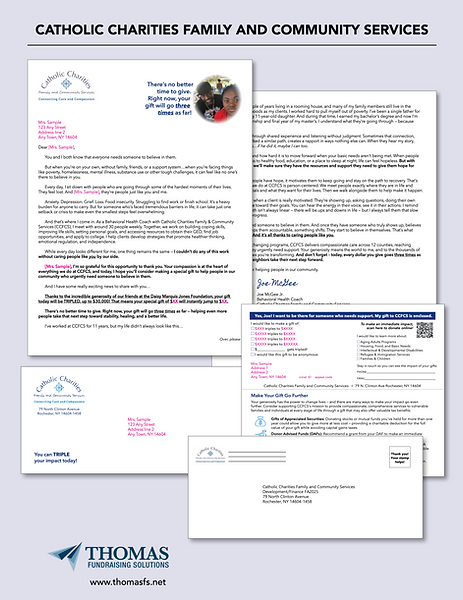
A consistent segmentation strategy was introduced across campaigns, allowing messaging to be tailored based on donor relationship, including more personalized versions based on different target audiences. Appeals were expanded to incorporate direct response best practices—such as stronger calls to action, more developed narratives, and improved formatting to increase readability and engagement.
To further strengthen acquisition performance, TFS introduced a modeling-based list strategy leveraging predictive analytics to identify high-potential prospects. By utilizing cooperative database insights, the program was able to prioritize individuals most likely to respond—improving the efficiency of outreach and expanding reach beyond the existing file with more qualified audiences.
At the same time, the program adopted a more aggressive growth strategy, increasing outreach to select longer-lapsed donors and acquisition audiences while testing new messaging, packages, and targeting approaches.
Results
This strategic shift led to meaningful improvements in overall program performance. Total revenue from appeals increased from $228,558 to $325,143 year over year—a 42% increase.
The expanded and more targeted outreach strategy also contributed to donor file growth. The program acquired 235 new donors and reactivated 254 lapsed donors, representing an approximate 41% increase relative to the starting base of 1,198 current supporters.
Importantly, the program established a stronger foundation for long-term growth. With segmentation, predictive targeting, and ongoing testing now embedded into the strategy, CCFCS is well positioned to continue improving performance, deepen donor relationships, and scale its annual giving program over time.
Conclusion
The shift to a more strategic, segmented, and data-informed annual giving approach marked a meaningful evolution in how CCFCS engages its donor base. By improving alignment between audience targeting, messaging, and acquisition strategy, the program was able to expand testing and establish a more intentional framework for growth.
These changes resulted in stronger performance across revenue, acquisition, and reactivation while also creating a more scalable foundation for future fundraising efforts. With segmentation, predictive insights, and enhanced campaign structure now embedded into the program, CCFCS is positioned to continue strengthening donor engagement and driving long-term annual giving growth.